Address
304 North Cardinal St.
Dorchester Center, MA 02124
Work Hours
Monday to Friday: 7AM - 7PM
Weekend: 10AM - 5PM
Address
304 North Cardinal St.
Dorchester Center, MA 02124
Work Hours
Monday to Friday: 7AM - 7PM
Weekend: 10AM - 5PM
Price was calm.
Then within minutes, it surged 10–15%.
Social media calls it a breakout.
Influencers call it momentum.
But in many cases, it’s something far more mechanical.
It’s a short squeeze.
Short squeeze crypto events occur when overleveraged traders are forced to liquidate, creating rapid and mechanical price expansions.
And most traders don’t fully understand how it actually works.
A short squeeze happens when too many traders are betting that price will fall — and price starts rising instead.
Because many of those short positions use leverage, even a small move upward can trigger forced liquidations.
When shorts get liquidated, exchanges automatically buy back their positions at market price.
That forced buying pushes price even higher.
And that triggers even more liquidations.
It becomes a cascade.
In leveraged markets, cascades are structural events — not emotional ones.
Simple structure:
That vertical spike?
Often not “strong buyers.”
It’s trapped shorts.
Understanding short squeeze crypto mechanics changes how you interpret volatility.
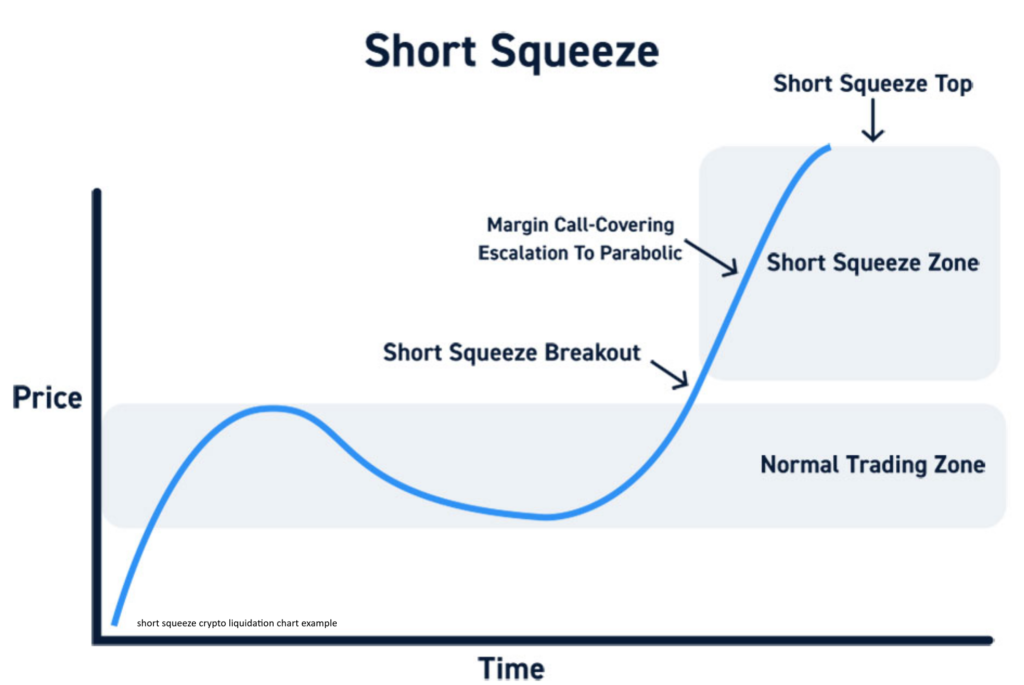
In volatile markets, a short squeeze crypto move often signals leverage imbalance rather than organic demand.
The difference between a breakout and a squeeze is visible in positioning data.
Watch this relationship:
In a true short squeeze, Open Interest often drops sharply while price expands.
That drop represents forced position closure.
This distinction is critical.
Many traders misinterpret squeezes as bullish continuation, when in reality they are positioning compression events.
Liquidations are not emotional events. They are automated risk controls.
When traders use leverage, exchanges calculate a liquidation price based on:
When price reaches that threshold, the exchange executes a market order to close the position.
Not limit.
Market.
That forced execution consumes available liquidity.
If order book depth is thin, slippage increases — amplifying the move.
This is why squeezes often appear violent and inefficient.
They are liquidity events.
According to data from Coinglass liquidation heatmaps, forced liquidations frequently cluster at obvious leverage zones.
Here’s where the deeper structure matters.
Before a squeeze, you’ll often observe:
When price taps the first liquidation pocket:
This creates a liquidity vacuum.
The move accelerates not because of aggressive buyers —
but because forced participants must exit.
A long squeeze mirrors the same mechanism.
Forced selling cascades.
Open Interest contracts sharply.
Price overshoots fair value due to mechanical liquidation pressure.
Understanding both sides prevents emotional misinterpretation.
Most traders lose money not because they can’t read candles —
but because they misread structure.
In our breakdown of Why Crypto Traders Lose Money we explain how structural misinterpretation leads to repeated losses.
We explored deeper liquidity behavior in our guide on Market Maker Manipulation in Crypto.
Short squeezes sit at the intersection of both psychology and liquidity mechanics.
They expose overconfidence.
They expose leverage abuse.
They expose positioning imbalance.
Professionals monitor:
They are not predicting direction.
They are identifying pressure.
When positioning becomes one-sided and liquidity is vulnerable, the probability of forced unwind increases.
The squeeze is not random.
It is structural imbalance resolving.
In leveraged markets, price does not move solely from buyers and sellers.
It moves from:
Short squeezes and long squeezes are not emotional rallies or crashes.
They are mechanical unwinds.
The trader who understands this no longer chases candles.
They monitor imbalance.
Most traders react after the squeeze happens.
By then, risk is elevated.
Structured traders monitor positioning and liquidation pressure before price expands.
That difference isn’t about predicting the future.
It’s about understanding how leveraged markets function.
Crypto doesn’t just move because of buyers and sellers.
It moves because of liquidations.
And when you understand that mechanism, volatility stops looking random.
Most traders only recognize a short squeeze after the liquidation cascade begins.
By that point, volatility is already elevated and risk expands rapidly.
Structured traders monitor positioning before the unwind.
They track:
Inside the Tradeflowedge Free dashboard, we track real-time squeeze pressure and liquidation positioning to help traders see imbalance before the cascade accelerates.
The goal isn’t prediction.
It’s preparation.